COEHS District Partner Teacher Residency (DPTR)
What is DPTR?
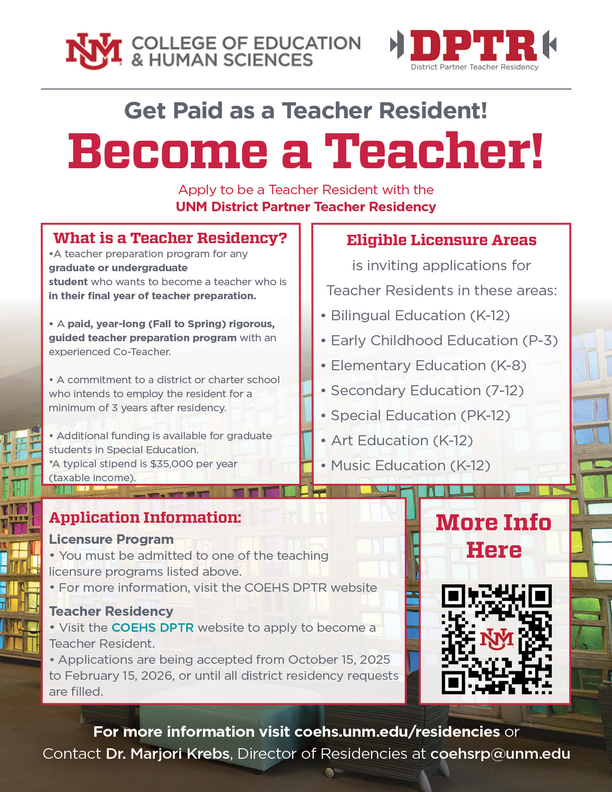
Teacher residency is a paid year-long rigorous guided apprenticeship with an experienced co-teacher. Residencies occur in partner Districts or Charter Schools that intend to employ the resident for three years post-residency. With funding from the New Mexico Legislature, the COEHS partners with several surrounding districts and charter schools to prepare teachers specifically to teach in these programs. Each year's funding must be approved by the New Mexico State Legislature.
Am I Eligible for DPTR?
You are eligible for DPTR if you meet the following qualifications:
- You are or will be admitted to a COEHS Licensure Program accepting Teacher Residents.
- You WILL be in your final year of your licensure program in Fall of 2026 and Spring of 2027.
- You WILL be interested in AND eligible for employment with your Residency district or charter school following your completion of your residency work.
- You WILL agree to be hired in your Residency district or charter school and remain for an additional 3 years as a full-time employee.
- You do NOT hold a Level 1 or Level 1A Teaching License.
- You will NOT serve as teacher-of-record during your Residency Year.
- YOU ARE ELIGIBLE TO WORK IN THE UNITED STATES.
National Center for Teacher Residencies (NCTR) State Policies to Support Teacher Residencies: An Overview is a new publication featuring the State of New Mexico and its policies to support teacher residencies.
Program Overview
Each District/Charter School in the DPTR is a unique partnership between College of Education & Human Sciences and select Districts and Charter Schools
Teacher Residents complete methods courses and student teaching in 2-3 semesters (Fall & Spring, or Fall, Spring & Summer)
As of Fall 2026, as a result of New Mexico Legislation (House Bill 30) Undergraduate Residents receive a stipend of $35,750. Graduate Student Residents receive a stipend of $44,000.
This stipend is taxable income. Residents will receive a Form 1098 for tax purposes.
Please understand the implications for your other financial assistance such as financial aid, supplemental income, supplemental housing allowances, child support, or other financial implications.
You may choose to use these funds for tuition, or securing other supports and scholarships to pay this tuition. See Financial Supports for Teacher Candidates below.
You may choose to opt out of funding for your Residency Year and still receive the benefits of being a teacher resident.
Each partner District and Charter School has an expectation to hire each Resident once they receive licensure along with a positive recommendation from the Residency School. Please note this is not a guarantee.
Residents agree to teach in their partner District or Charter School for a minimum of 3 years as licensed teachers in K-12 schools.
Residents are discouraged from holding jobs outside of DPTR teaching and coursework responsibilities.
2027-2028 District & Charter School Licensure Areas
More partners are added as information is received.
- Elementary (K-8)
- Secondary Mathematics (6-12) with preference for Middle School (6-8)
- Secondary Science (6-12) with preference for Middle School (6-8)
- Special Education (PK-12)
- Bilingual (with preference for Elementary, Secondary Mathematics & Secondary Science)
https://www.farmingtonschools.us/
- Elementary (K-8)
- Mathematics Secondary (6-12)
- Special Education (PK-12
- Music Education (K-12)
- Bilingual Education: Navajo Language [Elementary/Middle School]
https://healthleadershiphighschool.org/
- Mathematics Secondary (6-12)
- Science Secondary (6-12)
- Special Education (PK-12)
- Elementary (K-8)
- English Language Arts Secondary (6-12)
- Mathematics Secondary (6-12)
- Science Secondary (6-12)
- Social Studies Secondary (6-12)
- Special Education (PK-12)
- Early Childhood (PK-Grade 3)
- Art Education (K-12)
- Music Education (K-12)
- Physical Education (K-12)
https://www.mountainmahogany.org/
- Elementary (K-8)
- Secondary Education: English/Language Arts (6-12)
- Secondary Education: Mathematics (6-12)
- Secondary Education: Science (6-12)
- Secondary Education: Social Studies (6-12)
- Special Education (PK-12)
- Early Childhood (PK-Grade 3)
- Early Childhood (PK-Grade 3)
- Elementary Education (K-8)
- Secondary Education English Language Arts (6-12)
- Secondary Education Mathematics
- Secondary Education Science
- Secondary Education Social Studies
- Special Education
- Mathematics Secondary (6-12) Project-Based Learning Focus
- Science Secondary (6-12) Project-Based Learning Focus
Resources
Read data from the NCTR Survey of DPTR for 2025-2026.
Read data from the NCTR Survey of DPTR for 2024-2025.
Program Documents
DPTR Program Basics: Undergraduate Elementary Education
DPTR Program Basics: Graduate Certificate in Elementary Education with K-8 Licensure
DPTR Program Basics: Graduate Certificate in Seconday Education with 7-12 Licensure
DPTR Handbook 2026-2027
Summer 2026
- Download the DPTR Orientation Documents
- Down the DPTR Co-Teacher & Teacher Resident Orientation PowerPoint
- Download the DPTR Principal Orientation PowerPoint
- Graduate Programs
- Graduate Certificate in Elementary Education with K-8 Licensure
- Graduate Certificate in Secondary Education with 7-12 Licensure
- MA in Special Education (including licensure coursework)
- Art Education (K-12)
- Music Education (K-12)
- Undergraduate Programs
- Elementary Education BSED
- Secondary Education BAED/BSED
- Special Education Dual Licensure (Special Education & Elementary Education)
- Art Education (K-12)
- Physical Education (K-12)
- Music Education (K-12)
- Family & Child Studies: Early Childhood (PK-Grade 3)
SUMMER
Coursework:
- Some programs require summer coursework in June and July.
FALL
Coursework:
- Family & Child Studies: Early Childhood (PK-Grade 3): Coursework Mondays
- Elementary Education: Coursework Mondays, weekday evenings, and online.
- Secondary Education: Coursework Mondays, weekday evenings and online.
- Special Education (Graduate Level): Coursework Mondays afternoons and weekday evenings.
- Other Programs: Consult your Faculty Advisor for Coursework requirements.
Field Experience:
Time in classroom begins with the District Professional Learning Days for Teachers in late July or early August, depending on the Residency school’s start date for teachers. Residents serve in classrooms through the final day of the district or charter school calendar.
Full year in a PK-12 classroom following the school calendar for the entire PK-12 school year for the full teacher day on all Tuesdays-Fridays, following your school calendar.
- Early Childhood Multicultural Education (PK-3): Tuesdays-Fridays
- Elementary Education: Tuesdays-Fridays
- Secondary Education: Tuesdays-Fridays
- Special Education: Consult with your Faculty Advisor.
SPRING
Coursework:
- Some programs require summer coursework in June and July.
SUMMER
Following your residency year, Residents are strongly encouraged to complete the Bilingual/TESOL Summer Institute.
- Register as a Student Teacher in the Field Services Portal — fieldservice.unm.edu
- Provide proof of a district-specific cleared background check, fingerprinting, and liability insurance required.
- Be prepared to spend a full year in a K-12 classroom following the school calendar for the entire full teacher day.
- If you are in a field experience placement currently, as a student teacher or as an educational assistant, for example, please know that we will expand your experiences by placing you in a new school for your Teacher Residency. This will provide you with even more networking and mentoring opportunities during your teacher preparation year!
If you are moving to Albuquerque, we recommend the following resources:
- American Campus Communities (ACC)
They have a suite style dorm, Casa Del Rio, on campus, and apartment style dorms, Lobo Village, off campus.
This is a student-run housing website to assist you in comparing housing prices in Albuquerque.
DPTR partners with two national organizations to assist in creating, implementing, evaluating, and improving our program.
| Funding Source | Potential $$ | Details | Contact |
|---|---|---|---|
Teacher Preparation Affordability Scholarship (TPA) | Up to $6,000 per year over 2 semesters | Funding only for "unmet financial need" as determined by FAFSA application | |
Grow Your Own Teachers Scholarship (GYOT) | Up to $3,000 per semester | Must have been an Educational Assistant in New Mexico for a minimum of 2 years | |
TEACH Grant | Up to $4,000 per year | Must agree to teach in a high-need subject area in a high-need school for a minimum of 4 years | |
New Mexico Legislative Lottery Scholarship | Tuition funding | For Undergraduates only for up to 7 semesters. | |
Opportunity Scholarship | Tuition and fees | For Undergraduates only—1st Degree | |
Nusenda Scholarship (EAs only) | Funding varies | Must have been an Educational Assistant in New Mexico for a minimum of 2 years | APS Education Foundation: Nusenda Credit Union Scholarship |
New Mexico Workforce Connection | Tuition, fees, testing fees, books, etc. | Must be financially eligible. | Call Workforce Connection at 505-843-1907 to meet with a case worker to determine your eligibility. |
District Partner Teacher Residency (DPTR) | $35,000 stipend for 1 full year of clinical preparation. (Depends on approval of state funding) | Must a) apply to a District Partner Teacher Residency, b) complete a full year of clinical preparation, c) must agree to teach in your district for another 3 years. | Visit the COEHS DPTR Website and complete the application. |
Native American Teacher Preparation Program | Support for tuition, books, etc. | Must be of Native American descent | Visit the NATPP website |
HB 2 Paid Student Teaching | A one-time stipend for the full-time student teaching semester (depending on approval of state funding.) Amount has not yet been confirmed. | Must be participating in full-time (5 days per week) student teaching. May NOT be Teacher-of-Record | Visit the COEHS Paid Student Teaching website and complete the application |
Apply to be a Teacher Resident
If you are applying for the residency for the first time, please submit your application using the "Apply to Become a Teacher Resident" link on this website.
If you have applied for the residency previously and would like to change your priorities, please REAPPLY using the "Apply to Become a Teacher Resident" link on this website.
DPTR Applications for the 2027-2028 academic year are now open.
For best consideration, please apply by February 15, 2027. Applications close May 1, 2027.